
Regular Human Workshop Play Guide: Controls and Winning Strategies
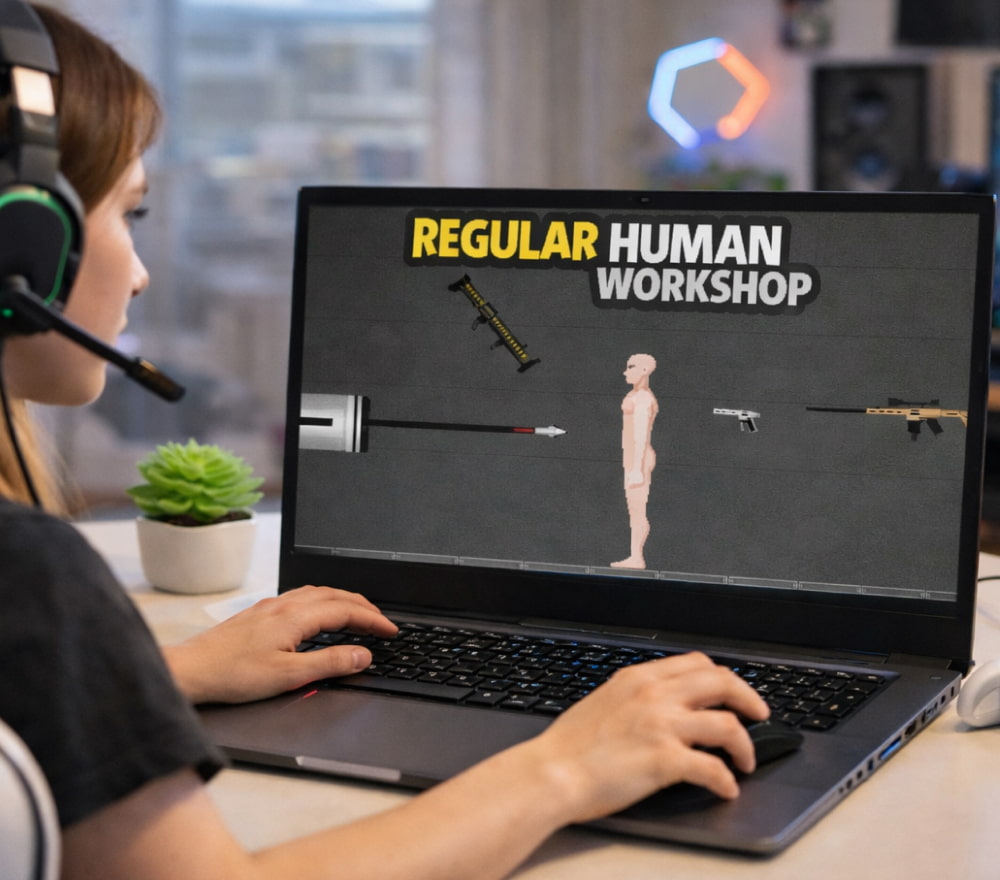
Download Regular Human Workshop for PC
Play NowRegular Human Workshop is at its best when you treat every task like a tiny engineering puzzle with a comedic twist. In this guide, you’ll learn how to move efficiently, coordinate with teammates, and avoid the most common “why is this not working?” moments while keeping the chaos fun and productive.
To get started quickly, many players look for Regular Human Workshop free-to-play options to explore the basics without pressure. Before you jump in, it helps to understand what the game expects from you: deliberate movement, clear roles, and simple plans that survive unexpected physics.
What You Do in a Typical Session
- Interpret the goal: read prompts carefully and identify the win condition.
- Assign roles: one player steers, another grabs, another stabilizes, and someone keeps time.
- Prototype fast: try a rough approach first, then refine.
- Reset smart: if a setup collapses repeatedly, change the plan instead of repeating the same steps.
“If you can describe the plan in one sentence, your team can actually execute it.”
Controls and Movement Fundamentals
The single biggest skill is learning how to reposition without overcorrecting. Small inputs beat big swings, especially when carrying objects or navigating narrow spaces.
- Walk, then adjust: move into a stable stance before you grab anything.
- Use corners: align objects by nudging them against walls rather than free-rotating in open space.
- Stabilize with your body: pin items gently to stop spinning or sliding.
- Communicate “hold” and “release”: calling timing out loud prevents accidental drops.
How to Coordinate Like a Pro Team
Most failed runs are communication problems disguised as “bad luck.” If you set expectations early, you’ll solve faster and argue less.
- Use short callouts: “left,” “raise,” “rotate,” “stop,” and “drop” are enough.
- Confirm actions: a quick “got it” prevents simultaneous conflicting moves.
- Limit leaders: one caller per phase keeps the plan consistent.
- Separate phases: build, test, then optimize—don’t do all three at once.
If you prefer instant access, Regular Human Workshop play online for free no download works best in a modern browser. Keep your session stable by closing heavy background tabs and using a wired connection when possible.
Common Scenarios and Reliable Solutions
| Problem | What’s Usually Happening | Fix That Works |
|---|---|---|
| Objects keep slipping | Too much force or poor alignment | Use tiny nudges, press against a wall, and stabilize before lifting |
| Team keeps colliding | Everyone crowds the same angle | Assign lanes: one lifts, one guides, one clears space |
| Timing-based steps fail | Unclear countdown or mixed cues | Use “3-2-1-go” and repeat the cue for each attempt |
| Progress feels random | No consistent plan between retries | Lock one variable at a time: same approach, then adjust one step |
Best Practices for Online Sessions
With the right setup, you can play Regular Human Workshop online smoothly even on modest hardware. Prioritize consistent frame rate and stable input over visual extras, because physics-heavy moments punish stutters.
- Audio matters: voice chat reduces confusion during lifts and handoffs.
- Keep latency predictable: avoid downloads and streaming during runs.
- Use short retries: if a plan fails twice, change the approach before frustration builds.
To reduce friction in group play, invite links and room codes are typically the fastest way to connect when you Regular Human Workshop play online with friends. Once everyone loads in, do a quick “controls check” so the first challenge doesn’t become a tutorial mid-run.
Role Templates You Can Reuse
These simple role patterns fit most cooperative challenges and keep your team from stepping on each other’s inputs.
- Driver + Spotter: one player moves the core object, the other watches angles and calls corrections.
- Carrier + Stabilizer: one lifts while another prevents spin, drift, or wobble.
- Builder + Tester: one assembles while the other runs quick checks and reports weak points.
- Navigator + Cleaner: one progresses objectives, another clears clutter and resets mistakes.
Strategy: Win Faster Without Losing the Fun
When everything is chaotic, your best weapon is consistency. Try to keep your plan simple, repeatable, and easy to explain—then iterate in small steps.
- Decide your “anchor”: choose one stable reference point (a wall, a platform edge, a marker).
- Limit simultaneous moves: one major action at a time prevents chain reactions.
- Call the reset early: a fast restart beats a slow collapse.
- Celebrate tiny wins: short morale boosts keep coordination sharp.
In co-op sessions, it helps to play Regular Human Workshop game roles deliberately rather than randomly. If someone is consistently precise with positioning, let them handle alignment while others focus on support tasks.
Safe and Helpful Progression Tips
You’ll learn faster by mastering fundamentals than by chasing “perfect” runs. Focus on handling objects cleanly, navigating tight spaces confidently, and communicating timing clearly.
- Practice controlled grabs: aim for gentle contact before you lift.
- Use the environment: floors, walls, and corners are tools, not obstacles.
- Talk through the plan: if it sounds complicated out loud, simplify it.
When budgets are tight, Regular Human Workshop play for free sessions still let you learn every core mechanic. Treat those runs like training drills: movement control, stable lifting, and teamwork habits matter more than speed at first.
Mini Checklist Before Each Challenge
- Do we know the win condition in one sentence?
- Who is lifting, who is guiding, and who is calling timing?
- What’s our reset rule if the plan fails twice?
- Where is our “anchor” reference point?
Quick FAQ
How do we avoid arguing mid-run?
Pick one caller per phase, keep callouts short, and use a consistent countdown for timed actions.
What if we keep dropping the same object?
Slow down, stabilize first, and use the environment to align it instead of rotating freely.
Is it okay to experiment?
Yes, prototype fast, then refine, and don’t be afraid to switch strategies if the physics fights you.
If you want a smooth browser session, it’s easy to play Regular Human Workshop online as long as your device stays responsive and your connection remains steady. Once your team builds a shared rhythm, even the messiest tasks start feeling like coordinated comedy instead of pure chaos.